Showing posts with label Summit NJ. Show all posts

Sunday, April 10, 2011

Fine Dining in Summit, NJ

Summit, NJ has a ton of restaurants. Having lived here for over fifty years, one tends to take it for granted to have such a wide variety of tastes available at such close quarters. Most are clustered across the street from the railway station in the downtown area. Many towns in America have only one diner and a fast-food stop to choose from.

When evaluating the tastes of the various eateries here (which I don’t intend to do), it must be kept in mind that we must already start from a very high bar. All of the restaurants must compete among each other. Bad food simply cannot survive.

Even with the downturn in our economy, the restaurant business has not suffered in Summit. On pleasant evenings one sees them simply packed. Many have set up tables and chairs on the sidewalk for outdoor dining. There are new places still in the planning stage despite the high rents and a town limit on liquor licenses. Most places encourage you to bring your own. As such, all three of the town’s wine sellers stay open late as to accommodate late diners.

I cannot show all of them here. Space does not permit me to do so. This does not mean that ones I have omitted are in any way lesser than the ones I mention. In fact, I haven’t even been to some of them and it would be unfair to compare. But after a while one picks up scuttlebutt about this and that.

There is one place, however, that deserves a special shout-out. This is The Summit Diner. It’s been around at least as long as I have. It does well and it’s difficult to get a seat around lunch time. Every time I’ve been there, the food has been exquisite. It’s hardly a salt lick as are so many establishments of its kind. Also, the portions are more than generous. After having eaten one’s fill, one is certain to still eat well for the rest of the week with what’s been brought home in the ubiquitous doggie bag.

Categories of dining in Summit include, Indian, Chinese, Persian, Italian, Japanese, Thai, Greek, American (steak house) and Mexican. If I've omitted any, let me know.

Peter Koelliker; pkoelliker8@yahoo.com


Monday, April 4, 2011

Spring (at last!) 2010

Spring can properly be seen as nature’s re-awakening after months of having been shrouded in winter’s icy breath. No politician can lay claim to the miracle, though many might try. In our part of the world, spring is eagerly anticipated – its sudden explosion of color, its warmth, its bird song; the shedding of unwieldy jackets, scarves and sweaters; and lower heating bills.

The first sign of spring this year was the rain. For the first time in a long while the stuff that fell from the sky didn’t have to be scraped off the driveway. Then crocuses began to appear just as the last of the snow melted on our lawns. Next, forsythia burst into flaming color, followed by various types of decorative cherry. White, gossamer Star Magnolia blossoms preceded fleshy Magnolia. Tulips and Hyacinths suddenly appeared in freshly dug beds next to the foundations of homes. Fields of yellow daffodils rivaled the sun. The Bradford Pear trees lining Morris Avenue in downtown Elizabeth (NJ) burst into white orbs, lending a distressed neighborhood its several days of dignity.

This year, we are blessed. Often, spring showers turn to deluge and beat tender blossoms into the ground almost as soon as they appear. This spring, the rains came early. A run of stable weather assures us of a prolonged season in which to enjoy our spring spectacle.

People show up at arboretums, parks and botanical gardens in droves - with children and camera kits in tow. Some travel as far as our nation’s capital – not to protest, but to join in the celebration of renewal among the world-famous Japanese cherry blossoms.

Spring represents the botanical Big Bang that repeats annually. Professional landscapers, however, know how to keep the botanical fireworks going throughout the year. They see to it that every month new, colorful blooms emerge. It all ends as spectacularly as it began, when the leaves explode into the stunning colors of fall.

Most of the world doesn’t have seasons as distinct as ours. Most visitors from such regions are impressed by what they see here. Our seasons have become the stuff of legend all over the globe. The last time my nephew (who lives in Brazil) was here, it was the dead of winter. He just arrived yesterday again. I can’t wait to see his reaction to what might catch his eye this time around.

I myself have spent many years taking our seasons for granted. It sometimes takes someone else’s eyes to open our own. No doubt, with the lengthening of days, we all feel better about things. But do we actually realize that we are feeling better? Are we awake enough to recognize the synthesis between how we feel and the state of what philosopher, Alan Watts, has termed our “external organs”? Do we allow ourselves the luxury of feeling reborn at the very same time that nature all around us beckons us to a fresh start?

Peter Koelliker; pkoelliker8@yahoo.com


Sunday, February 6, 2011

Art in Summit, NJ


On a recent visit to the town where I grew up in Germany, I noted that a lot of contemporary sculpture had inexplicably made inroads into the general landscape. I was told that the German government requires builders to solicit artwork to be displayed along side any new construction. The aim presumably is to give artists the opportunity to share in their community’s economic fortune – government-sponsored affirmative action for artists, if you wish.

I realize this column has visited Summit once before when we were discussing the Reeves-Reed Arboretum. Ironically, it was the man-made sculptures displayed there that drew our attention and not the roses, the daffodils, the sunflowers, hyacinths, etc. This time we return to Summit once more for here too modern sculpture has been cropping up in many of its public spaces. As it turns out, The Mayor’s Partnership for Summit Arts has been a force in bringing contemporary sculpture to the town so that people who may not necessarily be so inclined as to visit museums are also given the opportunity for accidental encounters (with modern art) just by going about their daily routines. Most works remain in place for about six months after which they are either moved to a new location or returned to the artist.

The program, in effect since 2004, has been successful in securing space for about 20installations in various parts of the city. The largest collection can be found in Wilson Park; but downtown, city hall, the high school and the train station have also become venues. In addition, three bus shelters along Broad Street have been outfitted with stained glass windows.

The Reeves-Reed Arboretum, of course, remains an attractive place for artists to display their work, as is the High School. These venues however have no direct connection to the Mayor’s Partnership.

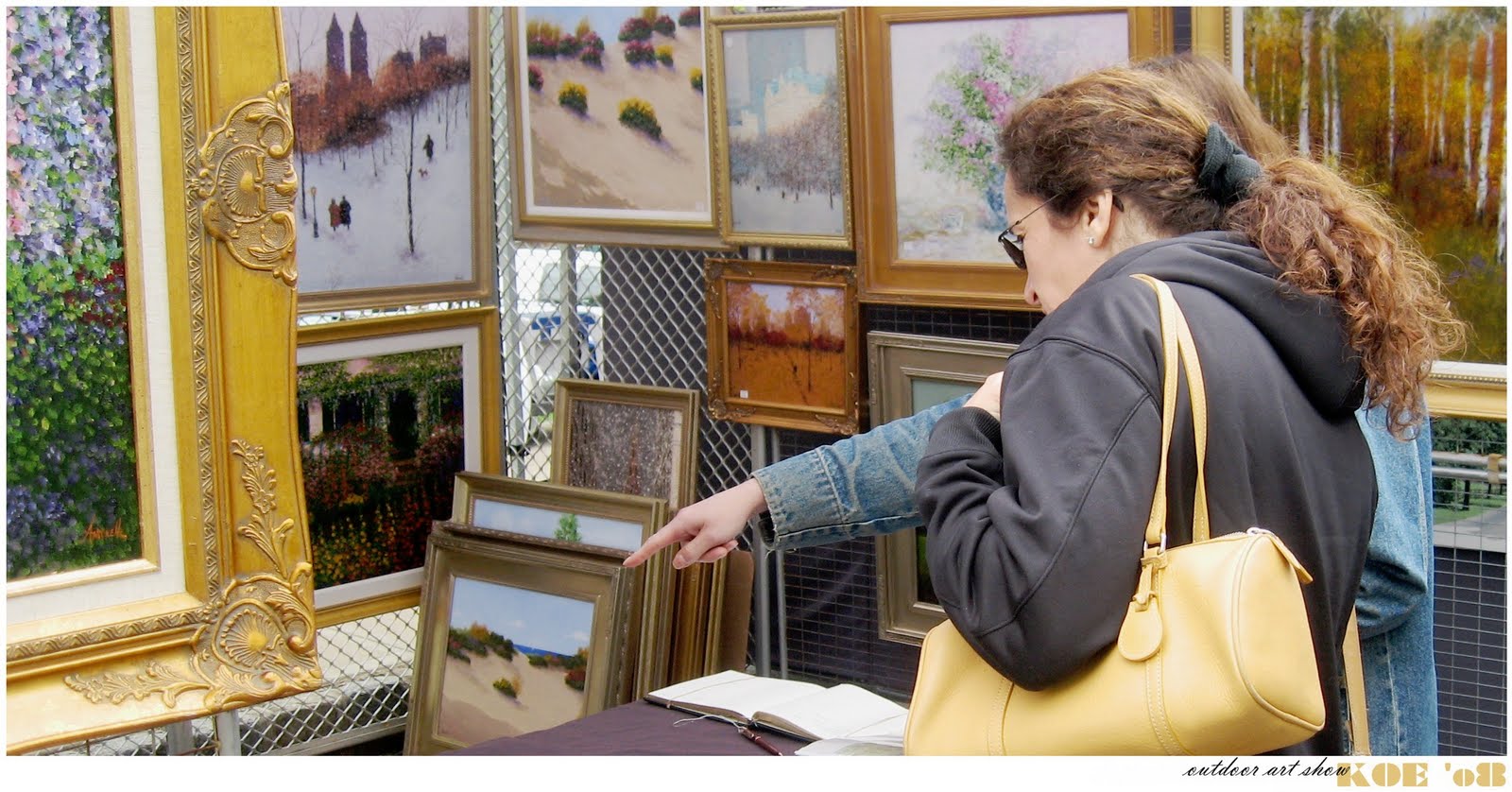
Connection or not, there is no doubt that all manner of art has been cropping up in Summit. This has always been a town with a soft spot for the finer things in life. The restaurants here are first class. The Summit Playhouse has been around as long as I can remember. There is also an Opera House, though no longer used for its stated purpose (only the name remains). Summit is also the New Jersey Center for the Visual Arts which features rotating exhibitions by established artists as well as Center students in a bright, modern facility. Summer evenings often feature concerts in the park. And don’t forget the annual art show for which several streets in down town are closed to traffic.

It might be instructive to mention that, unlike in Germany, all this activity is supported privately. I still remember when the German government decided that anyone claiming affiliation with a church would be required to pay a “church tax”. This effectively contributed toward emptying the pews.

Peter Koelliker pkoelliker8@yahoo.com


Thursday, February 3, 2011

Ice Storm


It’s been a rollicking winter in this part of the world. Every few days it snows. This makes it tricky for those who have steep driveways and jobs to get to in the morning. Even if you have a contract with someone to come and plow you out, chances are they won’t get there till late. They’ll have been busy all day.

So if you happen to have kids in the house, you’re likely to send them out with shovels. Even if they do a good job, it’ll be slippery. Backing the car down will likely end you up in a snow bank. This necessitates yet another round of shoveling - or rather, ‘digging out'.

Yesterday, on top of everything, we had an ice storm. This morning, every branch, every leaf was encased in ice. The driveway was so slick, you could practically skate down it and pick up the paper. After spreading sand or salt, you start the car and ease it out of the garage. So far so good. What happens next is predictable because its happened before.

Once you hit the slope, the car begins to slide. You remember someone saying, “Keep the wheels turning; don’t hit the brake.” You check the rear view mirrors, but all you see is white. The car pulls to the right. You turn the wheel to compensate. Too late! You’ve hit the snow bank and you’re stuck.

Forward is impossible. Too much gravity working against you. Backwards is blocked. You can throw all the sand you want under the wheels, they’ll just keep spinning (unless you have four wheel drive).

Such are the joys of living in a temperate climate. There are flashing lights down the block. The electric company has come out. Then you notice that the houses across the street don’t have power.

Now you feel better. It can always be worse. You go back inside and make yourself a cup of coffee. Then you call the boss to tell him you won’t be in today.

Peter Koelliker; pkoelliker8@yahoo.com


Wednesday, December 29, 2010

Bryant Park, Summit, NJ


We sometimes forget that scenes of winter do not necessarily have to include snow and ice. Whereas the white stuff is in some ways symbolic of the season, recent years have shown that the traditional White Christmas need not necessarily be white. Even so, there is still plenty that brilliantly distinguishes the dormant season from the others – even beyond the spike in utility bills - whenever one is so moved as to venture outdoors.

The most obvious indication of the winter is trees and plants. Most of us ignore the dry, brittle, often thorny stuff as much as we open our hearts the tender greens of spring. We often fail to see the majesty of exquisitely branching trees that bring Benoit Mandelbrot’s theoretical ‘Fractal Geometry of Nature’ to stunning life; of the deft tangle of underbrush; the yellowing grass and the crunch of dry leaves underfoot. Even when viewing the accompanying pictures in the comfort of a properly heated home, one gets a whiff of the cold air that seems to expand so pleasantly in one’s lungs; that crisp feeling of Zen-like awareness; energy ignited and coursing through one’s limbs, urging one to stride swiftly; while every detail of nature outlines starkly on a canvas of muted colors.

Summit’s Bryant Park is similar to any popular gathering place in any town. It’s a draw for outdoor enthusiasts whatever the season. There’s a walking path that circles a duck pond. Along it, there are numbered stations, each with a line drawing that describes some particular exercise. Dogs are allowed as long as their owners consent to clean up after them.

Peter Koelliker; pkoelliker8@yahoo.com


Monday, December 27, 2010

Snow Job


I woke up this morning to the biggest snowfall in years. It had been snowing yesterday already. It was wet and heavy. We had gone out periodically and cleared the driveway. And it was alright when we went to bed. Overnight, though, the light, fluffy stuff really accumulated. I hadn’t seen it like this in decades. I remember, back in the early sixties we used to get snows like this. I remember one time my father and I were out there at the crack of dawn shoveling furiously. We had to get it done because we had tickets on a flight out of Newark to the Caribbean in the early afternoon.

There has been only one time since when we had this much snow. I remember there were a couple of days in a row they’d closed the shop because of snow and severe icing. This was unusual nevertheless. The company I worked for at the time had people working even on Christmas. I got up on the third morning and was met by quite a sight. The snow was back up to between my knees and my waist. My muscles were still aching from the previous day’s work. And now, all I had previously done had simply vanished; blown over; buried. I felt dejected and desperate. I could not imagine getting to work ever again. (Too many absences in a row tended to count against you.)

Not only was there three plus feet of snow on the ground, there were also several trees that had lost their branches, some of which were now blocking the driveway. I tried to drag them aside, but they were hard frozen to the ground. I went back inside and called my boss. He wasn’t too happy and offered to send someone over to pick me up. It turned out to be only a temporary fix, as you can well imagine.

Today it seems like the same kind of snow all over again – the kind that even outdoor cats generally want no part of. So, you have to physically heave them out into the white powder, otherwise, they’d happily just stay in the house ‘til spring. Poosa, the pink-nosed tabby we had at one time, would sink to the bottom and stay there. After a while, you begin to get worried and start digging for her. And there she was, ears held flat, looking terribly embarrassed. She’d been doing her business like a good girl. We never kept a litter box in the house.

Today, it was easier. We no longer have a cat and my son came to help me. Together, we got it done – even though our shovels had practically disintegrated during what can now be described (meteorologically) as having been quite an active winter season.
-------------------------------------------
Note: This article was written last winter. Yesterday it happened again (to kick off the season, I suppose. This time there were three of us to shovel. My brother was here as well. I must say, the three of us had fun.

Peter Koelliker; pkoelliker8@yahoo.com


Thursday, December 23, 2010

Reeves-Reed Arboretum, Summit, NJ


At first blush one wouldn’t think that formal gardens and modern sculpture would have much in common, much less be compatible within the confines of a similar context. Both can be considered as contrived, to be sure; both relying heavily on such divergent media to make their point as to make it difficult to imagine them melding into any semblance of a unified, coherent statement. Aristide Maillol and Henry Moore put the lie to this notion, however, as both have held very successful exhibitions of their work at the Bronx Botanic Garden in New York in recent years.

The city of Summit, gracefully perched along the crest of the first ridge of hills comprising the Watchung Mountains directly east of New York City, can rightfully claim one of the finest gardens, the Reeves-Reed Arboretum, among its many treasures. According to its website, an arboretum, distinct from a park, “is an educational conservancy promoting the awareness that the natural environment needs protection and deserves concern.”

Reeves-Reed didn’t just happen. It is the product of well-established landscaping principles pioneered by such giants in the field as Ellen Biddle Shipman and Carl F. Pilat. Most notably, it introduced the concept of the “garden room” which would go on to define the direction of country estate landscaping and is currently liberally reflected in the gardens surrounding many of Summit’s private homes.

Now owned by the city, Reeves-Reed exists as a glowing testament to the town’s long-standing tradition of philanthropic giving, the most recent transaction (with regard to this particular garden) occurring as recently as 2007 when George Morrison Hubbard, Jr. donated a field and adjacent land to the Arboretum, bringing the property back up to its historical dimensions.

Not to be outdone by its wealthier and, hence, more publicized neighbor in New York, Reeves-Reed also is experimenting with the introduction of modern art into it’s gardens. 2008 marks the second summer in which this has been done. One exhibit in particular captures the very essence of the Reeves-Reed Arboretum this season. It is David Bender’s “Excavating Eden” which shows a human hand in rough approximation of the shovel on a backhoe. We as visitors, who come to enjoy this garden for its roses, its daffodils, its flowering trees, and indeed its sculpture, must be aware of all the work that continues to go into maintaining it. My Indian-born wife often remarks that such things are only possible in prosperous countries. She casts no aspersions; she simply utters what is accepted as fact by many. And perhaps it is so. Where else would people find time to excavate Eden and plant it with trees and beautiful flowers; to create sparkling ponds and walkways through wooded areas? Where else would men and women devote their energies to purely artistic (as opposed to “practical”) projects that, more often than not, fail to reap monetary payback or even gratitude? And yet, it’s all on glorious display here for all those with an abundance of leisure time to enjoy the fruits of mankind’s more refined moments.

For directions, schedules and events consult their website: www.reeves-reedarboretum.org


Saturday, July 24, 2010

Tea Parties


When traveling to the Far East (from New York), there’s often a stop-over at Heathrow in London. I always enjoy getting off the plane after a trans-Atlantic flight and stretching my legs before the next leg. I browse the shops which often display goods that are typical of whatever country I happen to be in. At Heathrow there’s an emphasis on tea service: pots, cups and saucers, world famous (tea) brands, and richly embroidered cozies.

It’s fun to imagine all those refined English ladies taking high tea in their elegant drawing rooms, snacking on cucumber sandwiches, just beyond the treeless wasteland this (or any) airport represents. It’s delicious to think about their fresh, pink-cheeked maids, gingerly picking up porcelain shards off the black and white checkerboard kitchen floors with pale, trembling fingers.

They remain unaware of the big world outside, cleaving to ancient traditions that includes strict punctuality; no thought lent to the mysterious origin of the tea leaves themselves - the terraced gardens of Darjeeling, India, and those of what was once known as Ceylon.

I think of my mother’s hutch in her dining room at home and take note that the tea drinking tradition (or a part of it) has even found its way across the Atlantic to the New World. Only here it serves primarily only decorative purposes. The china remains unused and gathers dust while the coffee urn in the kitchen is stained a deep brown with use.

I remember, not too long ago, a tea room opened in the New Jersey town where I live off and on. It was bright and airy featuring translucent china, tea cozies and such. There were delicacies served on white bread with the crusts cut off. But nobody went - or not enough. The shop closed down after barely a month.

Back on the other side of the globe, in Chennai, India too, there was a shop my wife and I sometimes frequented, featuring the most exquisite teas. It closed as well. Meanwhile, the hole-in-the-wall shops, ten to a block, each prominently advertising ‘3Roses’ (bitter) tea (dust), are thriving.

I heard of an Indian girl sent to Leeds for an education practically dying of homesickness. Ultimately the problem was at least partially solved when she asked her parents (back in India) to send her a packet of ‘3 Roses’ tea.