Showing posts with label South India. Show all posts

Sunday, April 3, 2011

Kanyakumari, Tamil Nadu, India


About 30 years ago, I participated in a six-month study program at the University of Mysore in South India. There were about a dozen of us from colleges all over the country. None of us had been to India before and we were quite overwhelmed by everything there.

My first glimpse of India has remained etched in my mind and I can recall it as if it were yesterday. We were coming in for a landing at Delhi and I was glued to the window. Below, at fairly close quarters, I saw a man plowing a field with a camel pulling the plow.

Initially, we stayed in New Delhi for about a week. We occupied six rooms at the local YMCA hotel near Connaught Circle. Only three of them were air-conditioned. As we landed in mid-summer, during the hottest part of the year, we drew straws. I drew a short one; hence, no A/C. This turned out to be good for the looser group as half our team developed a severe case of the sniffles. Neither were we spared entirely. We too would suffer digestive problems.

After a few days of sight-seeing in Delhi and Agra, we set off for Mysore by train. If I remember correctly, we didn’t do it all in one shot. I remember overnighting in Pune. Mysore University was sprawling. We were enrolled in a number of classes including one that was supposed to teach us Kannada, the local language. I’m afraid, our professors did not see much promise in us.

After a couple of weeks, our chaperone announced that we no longer needed to attend classes. We could return home if we wanted – or, we could stay. Nobody wanted to go home. Instead, we decided to travel. Everyone had a different idea about where they wanted to go. We decided to break up into small groups and hit the road to various destinations, always returning to base. Eventually these would evolve into regular odysseys of indefinite duration.

One of my very first ventures was to find Kanyakumari at the tip of India where three oceans meet. A friend and I took a bus and headed south. It took days and days. I remember sitting at the window cursing myself for not having attended to my vision. At one point, the bus stopped and someone pointed out a group of wild elephants crossing a ridge. I could barely make them out.

Eventually we would reach our destination. It looked a place as any other – somewhat isolated and remote. The sea was beautiful to look at.

Thirty years later, my wife and I were visiting Trivandrum – her birth place – and from there it was just another hop-skip-and-a-jump to Kanyakumari (on the map). We decided to go for it. I became concerned when this involved crossing back into Tamil Nadu where we were stopped at the border. I had forgotten to bring my passport. It turned out not to be a problem.

When we finally reached there, I found it was nothing like I remembered it, which was in some ways understandable. A lot can change in thirty years. Mahabalipuram (just south of Chennai) in Tamil Nadu had completely changed, even to the point of being unrecognizable. But there was something else: On two rocky islets just off the shore, southeast of the Kumari Amman Temple, are the Vivekananda Rock Memorial (built in 1970) and the gigantic 133 ft. tall statue of Tamil saint-poet, Thiruvalluvar. I do not remember seeing either of these on my first visit. Neither did I remember seeing islands of any kind.

The mystery remains: Where had we been when my friend and I thought we were there back in ‘72?

Peter Koelliker; pkoelliker8@yahoo.com


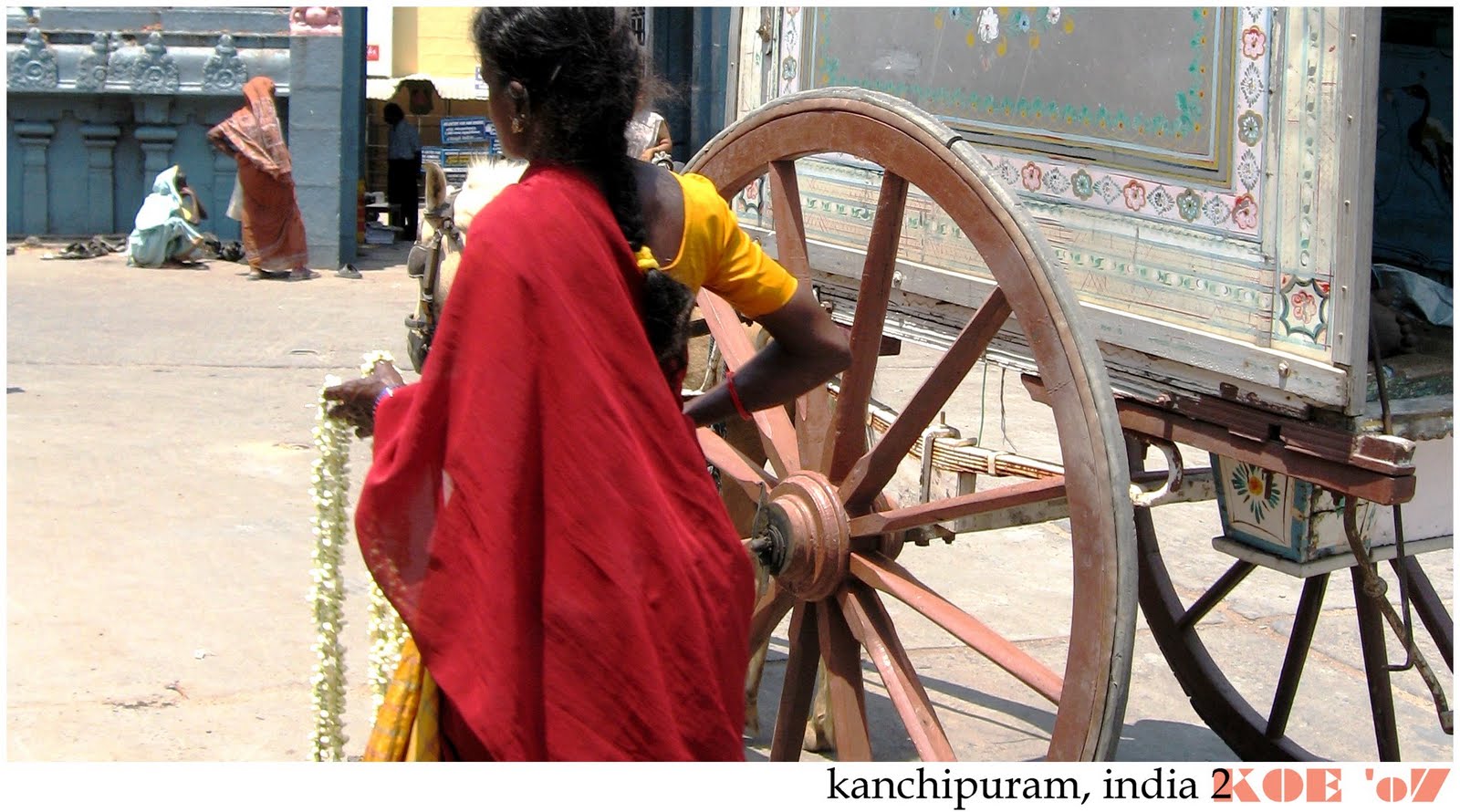
Kanchipuram, Tamil Nadu, South India

It's pesky thing in India: Some places they allow you to take pictures, some places they don’t. Some places they charge you extra for bringing a camera; everywhere, it seems, they charge exorbitant fees for bringing a camcorder. Obviously, they haven’t figured out yet that today’s cameras can do both: take stills as well as moving pictures. But, the most annoying of all is when you’re just not ready for that unexpected money shot when it happens.

It’s probably one, or any combination of the above that happened to me while visiting Kanchipuram (the city of one thousand temples) in Tamil Nadu, so I just have to paint you a word picture: Apart from the obvious, we had heard of an ancient Jain Temple that was said to be undergoing renovation. Our driver managed to find it. Not much work was evident here; in fact, it was mostly a ruin. It was in a part of town where outsiders seldom visit; therefore, our car caused quite a stir. We had come to see the temple we explained to the people who crowded around us. Soon somebody sent for the old woman who lived down the block who, it was said, had been entrusted with the key.

By the time she showed up with a key that was almost as big as herself, the crowd was still growing. We were told that this particular temple, though now mostly in ruins, held a most beautiful idol in its inner sanctum. The crowd parted to let the old woman through. She stepped gingerly across the rubble on calloused feet and led us to a great wooden door. An ancient lock secured the bolt. It looked like it hadn’t been opened for centuries. As she struggled with the key, we began to have doubts.

Finally, it clicked and the lock sprang open. Some youths rushed forward to help her with the door. It shuddered and creaked in agonizing protest. Every inch was fought. More brawn was added and, at last, the great door swung open. There was a tremendous sound emanating from the inside; it gathered, and virtual cloud of black bats flew out from the darkness, their wings stirring a breeze that ruffled our hair on an otherwise breathless afternoon. More bats followed in volleys.

The sight was so strange; I forgot to reach for my camera. In fact, it felt like I had been transported back to a time when there were no cameras. I even doubted my own existence.

At first, there was nothing to see in the blackness inside. We squinted our eyes. Then, suddenly, we saw it: the idol. It was beautiful, indeed. I now understood why it needed to be locked up. Not that anyone of faith would steal it. It seemed inviolate. But there will always be those who would cart something sacred away to exhibit in their own carnival.

It seemed to shine with a light of its own, especially from a face that was the very definition of serenity. Again, I failed to reach for my camera. To take a picture now seemed the very definition of gauche.

The accompanying photos here are of Kanchipuram, a busy and chaotic South Indian city with a rich historical tapestry. Every one of its temples is notable, each with a rich history of its own. A person with a camera could easily spend himself and dissolve into a pool of sweat in the unrelenting tropical heat before having recorded even a fraction of all that is here to see. For a brief instant I was blessed, being afford a moment that went even beyond seeing - beyond time. It is therefore altogether fitting that no record exists.

Peter Koelliker; pkoelliker8@yahoo.com


Monday, March 28, 2011

San Thome Cathedral, Chennai, India


Whereas in the West, Catholic priests generally wear black robes, here in India – perhaps in an appropriate concession to the heat - they are more likely to wear white. Similarly, Christian churches here are overwhelmingly white(washed). And so, possibly the most important Christian church in all of India, the one Pope Pius XII himself elevated to the status of a minor basilica in 1956, is a great gothic monument - brilliantly white - overlooking the Bay of Bengal from the modest hill on which it was built over the remains of St. Thomas (Doubting Thomas), one of Jesus’ own twelve apostles.

Hinduism, the dominant religion in India, has always been exceptionally tolerant of other faiths. I have seen statues of the Virgin Mother lovingly attired in colorful saris; I have seen images of Jesus alongside the deities in Hindu temples. There has been some hardening of this ecumenical position of late in response to Islamist fanatics hell-bent on desecrating anything that is not Islam.

Legends of St. Thomas’ life in India abound. At one point, it is said that a huge log washed down the Adyar River and got stuck at its mouth, causing significant flooding upstream. The king called out his army to dislodge it. Try as they might, they couldn’t budge the log. The king had heard rumors of an ascetic living in a cave up in the hills of whom it was said that he could perform miracles. The king sent a messenger to fetch him. St. Thomas came; touched the log with the girdle the Virgin Mother had dropped at the time of her assumption, which St. Thomas always wore around his waist; spent some moments in silent prayer and then asked the king’s men to pull the log aside. They were able to do so without difficulty.

The belief in St. Thomas’ ability to perform miracles continues to this day. Christians from far and wide converge steadily on San Thome Cathedral to pray for the Saint’s personal intervention in regard to some problem they might be experiencing. In December of 2004, when the tsunami hit the east coast of India, it is now widely believed that St. Thomas’ Pole (fashioned from the legendary log) which stands between the sea and the church, was responsible for saving the lives of the people living in the Foreshore Estate, a neighborhood comprised primarily of fishing villages.

San Thome Basilica in Chennai is well worth a visit. There’s a delicious irony between Indian exotica and the (starkly geometric) cross. Besides the grand interior of the Basilica, the complex contains the Eucharist Chapel, the Tomb of St. Thomas (also with Chapel), a modest museum, boasting of St. Thomas relics such as the spearhead that killed the beloved saint.

There is a small gift shop where any number of items associated with St. Thomas can be purchased. By far the most popular item is a wallet size card embedded with the sand from the Saint’s tomb which is said to have miraculous healing powers. Other items include post- and laminated prayer cards in various Indian languages as well as a quarterly news magazine entitled, Voice of St. Thomas.

Peter Koelliker; pkoelliker8@yahoo.com


Peter Koelliker; pkoelliker8@yahoo.com

Thursday, March 10, 2011

Kochi, India


Kerala is in many ways a paradox. It is one of two Indian states that boast of having a Communist government. Kerala (along with Bengal in North India) is touted as having the highest literacy rates on the sub-continent. This singular political and educational distinction has not come without cost. Heavy government interference in the private sector – regulation; taxation – forces many young men to seek employment elsewhere. Malayalam (the language of Kerala) is liberally heard in neighboring Karnataka and Tamil Nadu (where I presently live). My dentist is Malayali; the internationally known movie play-back singer, Yesudas, down the street from us, is a Malayali; 60% of the hospital nurses in the West are Malayalis. And nearly every Kerala family has someone working somewhere in the Middle East – so much so, that announcements at the airport in Dubai are also given also in Malayalam (anybody notice that the word is a palindrome?)

My first encounter with Kerala was Kochi (or Cochin as it was then called). On the ride from the airport, the differences between Tamil Nadu and Kerala become immediately apparent. There was hardly a stray dog to be seen. Also missing were oxcarts, and cows wandering aimlessly about in major traffic. The streets seemed much cleaner than those across the border. The vegetation differed too; much more of what you’d expect a tropical island paradise to be. Of course it rains steadily for four months out of the year. Consequently, roads are built with run-offs as to remain passable even during the monsoon season. (Unlike in Tamil Nadu where, when it rains only a little, knee-high water routinely collects on the streets.)

Kochi is the commercial center of Kerala by virtue of its excellent harbor. Travelers and spice traders from all over the world – from the Chinese to the Romans – have been stopping here for centuries. Many ancient accounts by seafarers and traders make reference to the convoluted history of this sliver of a state that hugs the lushly tropical Malabar Coast.

Kochi is made up of Ernakulam on the mainland plus a series of islands (at least one of these man-made). A tour boat takes you around the harbor, making frequent stops. Of these, the most fascinating is Jew Town which once housed a significant Jewish population and claims the oldest synagogue in India. It’s a must-see for all those whose Asia cruise liners stop here. The narrow streets have one antique shop after another, crammed with wonderfully tempting treasures to suit every taste and budget. There are also a few western-style restaurants with excellent reputations.

Another must-see are the Chinese fishing nets and the Church of St. Francis where Portuguese adventurer, Vasco da Gama lies buried.

For those able to spend a few days, there are the refurbished rice boats that take you along the inland waterways in style, stopping here and there to enjoy the delicious (coconut-based) Kerala cuisine. If you’re extremely lucky, you may even witness Kathakali, a unique form of classical dance theater that is somewhat similar to Japanese Kabuki. Performances are generally held at night by the light of a single oil lamp (Aatta Vilaku) with sixty wicks. Some say Kathakali is the “art of the non-worldly”.

Peter Koelliker; pkoelliker8@yahoo.com


Monday, February 7, 2011

Sravanabelagola, Karnataka, India


Sravanabelagola is just a day trip (about 100 km) from Mysore in the South Indian state of Karnataka. In fact, it’s often bundled together by Mysore tour bus operators with stops at two ruin cities of the Hoysala kingdom, Haledid and Belur - splendid temples at both locations.

Shortly after we arrived as exchange students at Mysore University back in ‘74, our chaperone arranged for the twelve of us to take this very tour. We were eager to get out and see something of the countryside with our cameras at the ready. Our sprawling campus had already become somewhat too claustrophobic for our tastes.

Of the three sites, Sravanabelagola was by far the most dramatic. This was said to be one of the most popular Jain pilgrimage centers in South India, and is known for its colossal monolithic statue of Gomateswara at the top of a hill. (All Jain pilgrimage sites are atop of hills.) We climbed the time-worn steps that went up the mountain. And that’s exactly how it was. Not only was there a giant statue, but Jain priests were busy conducting a ceremony, pouring milk, curds, ghee and saffron over the naked stone idol. I stood there and watched in wonder and took a picture.

Thirty years later would find me in Mysore once again. My wife and I signed up for the three-site tour. Sravanabelagola was our first stop. I was eager to see it again. Nothing much looked familiar, but that was to be expected after so many years. There was a brand-new entrance gate at the bottom. We started our climb. Somebody said there are 500 steps to the top. Indeed, we could not see the top. We climbed higher and higher. Now and again, naked men passed us going the other way, their faces smeared with ash. We stopped frequently to catch our breath and look around. The higher we climbed, the stronger the breeze became. It felt good.

At last we reached the top. The sheer size of the statue took my breath away. It stood serenely atop of the mountain and had bamboo scaffolding all around it. My mind balked. I tried hard to reconcile what confronted me at that moment with my admittedly sketchy memory of same. For one thing, this statue was gleaming bright under the clear Karnataka skies. The one I remembered was black (which was entirely possible for, I was told, the ghee poured over the stone sometimes had the tendency to turn the stone dark). Yet, I grudgingly decided that this was not the same statue I had seen the first time around. If I had, I would have remembered it. It’s sheer size alone made it unforgettable.

And this remains a mystery. Where exactly was I when I thought I was there thirty years back? There was another hill in town. I thought maybe, back then, we had climbed the other one. I searched the internet, but found nothing even close to what I remembered at that location. I asked my professor who had been in charge of us back then. I asked my wife who had grown up in Mysore and made this pilgrimage any number of times. All came up empty.
-----------------------------------------------------------------

Today the mystery was solved. It seems that not 20 km from Mysore there’s
Gommatagiri. A 700-year-old statue of black granite stands atop a fifty meter tall hillock called 'Shravana Gudda'. This statue of Gomateshwara is said to be an early Vijayanagara creation . The center attracts many pilgrims during the annual ‘Maha masthakabhisekha', held in September. That would coincide with the time we were there.

The statue at Gommatagiri has a striking resemblance to its famous counterpart in Sravanabelagola except that it is dwarfed by comparison. Googling Gommatagiri and then clicking on images, I finally solved the puzzle that had haunted me for nearly half a lifetime.

Peter Koelliker; pkoelliker8@yahoo.com


Wednesday, December 15, 2010

Vishnu


The Hindu trinity consists of three gods: Brahma (the creator), Vishnu (the preserver) and Shiva (the destroyer). Of the three, Vishnu and Shiva are the most popular. Temples are built specifically for the worship of either Vishnu or Shiva. One of my previous postings identifies the Kapaleeswarar Temple in Mylapore as a Shiva temple; another identifies the Ashtalakshmi Temple in Chennai as a Vishnu Temple. There are almost no temples dedicated to Brahma.

Vishnu is said to have appeared in nine incarnations. Most of them were killers who came back specifically to kill demons. The first (Matsya), ninth (the Buddha) and tenth (who is yet to appear) are the exception.

This post contains illustrations of six of these. Most pictures were taken at the Naya Tirupathi Temple in Madurantakam (interior Tamil Nadu). Depictions of nine of the Vishnu avatars were featured there. As there is some dispute among the various Vaishnavite sects as to whether or not the Buddha qualifies as one of Vishnu’s avatars, this particular depiction was missing at the Naya Tirupathi Temple.

Peter Koelliker; pkoelliker8@yahoo.com

The ten avatars of Vishnu:
1. Matsya - fish
2. Kurma - Turtle
3. Varaha - Boar
4. Narasingha - man/lion
5. Vamana - dwarf
6. Parasurama - warrior
7. Rama - king
8. Krishna - god
9. Buddha
10. Kalki - horse


Wednesday, September 22, 2010

DakshinaChitra Redux: Lord Ayyanar


I recently visited DakshinaChitra again. There is so much to see here, one visit is not nearly enough. This time, their Ayyanar statuary collection caught my eye. Lord Ayyanar is a Hindu village god, worshipped predominantly in the South Indian state of Tamil Nadu and in Tamil villages in Sri Lanka. He is primarily worshipped as a guardian deity who protects the rural villages. His priests are usually non-Brahmins, who belong to mostly the potter caste, but other caste members also officiate in his temples. The temples of Ayyanar are usually flanked by gigantic and colorful statues of him and his companions riding horses or elephants.

The Tamil word Ayyanar (or Aiyanar) is derived from the root word Aiyā which is a title often used by Tamils, Malayalees and Telugus to designate ‘respectable’ people. The word derives from the Proto-Dravidian term denoting an ‘elder brother‘. It is used in that meaning in various South Indian states. Yet some derive the word Aiyā as a Prakrit version of the Sanskrit word ‘Aria’ which means 'noble’.

Interior South Indian villages often exist outside the reach of the central government. Yet for countless generations they have functioned well and effectively based on an emphasis on civic duty, and codes of honor and respect. It is not necessarily a utopian model as we commonly see it in modern communism. Though there are such elements inherent here as well. But rather than an emphasis on a nameless state, it’s power derives organically from an acceptance of the wisdom of elders who perpetuate an appreciation for strict ancestral lineage.

As the agrarian villages have prospered, the Ayyanar statuary came to be painted in bright, modern colors. The DakshinaChitra collection adheres to the older version in which color has yet to been introduced.

Peter Koelliker; pkoelliker8@yahoo.com


Sunday, September 19, 2010

DakshinaChitra: Picture of the South


DakshinaChitra literally means “Picture of the South” in Sanskrit. It is a popular Chennai (formerly known as Madras) tourist destination only twenty-five kilometers south of the city along the East Coast Road at Muttukadu. Its ten rolling acres overlooking the Bay of Bengal contain representative dwellings from four South Indian states: Tamil Nadu, Andhra Pradesh, Karnataka and Kerala. Each home is furnished in the appropriate regional style. Weavers, potters and the other craftsmen give continual live demonstrations of their regional arts and crafts. In addition, DakshinaChitra can also boast of having a wonderful art museum, a gift shop and an open sky amphitheatre where music and dance performances are often given.

On my last visit, the theme was ‘Asia’. Accordingly, a classical music group from Japan had been invited to perform. After the Japanese Consul General had said a few words by way of explanation, we were treated to a fine performance of Japanese dance. Earlier various delicacies from five different South East Asian cuisines were offered for sampling – all, prepared and provided at nominal cost by top Chennai hotels.

On a prior visit to DC, a Kerala Theyyam dancer had come to perform and pose for pictures. He was dressed in full and stunning regalia, dancing up a storm, bare feet stomping the hot dust until our own teeth rattled in time with his silver ankle bells. It was a truly inspired performance quite in keeping with DC’s usual standards.

DakshinaChitra lists the special events it has contracted for on its informative website. Even without anything of note scheduled, DC is well worth a visit. Within the time it takes between arriving at any given airport and taking off, one will have had a taste of the diversity that is South India. It is recommended that you watch a 15-minute film before starting your tour. Guides are available but not mandatory. Exhibits are clearly marked, their relevance explained in English.

Above all, DakshinaChitra is a peaceful place. The ride down from Chennai along the East Coast Road by hired car is likely to put your nerves on edge. There’s nothing like entering the lush green park-like setting and leaving the bustle of modern India behind. I suggest you arrive around lunchtime and relax with a traditional Indian thali at DC’s excellent restaurant before going on your exploratory tour.

Unlike in many places – even back in the States – here at DC the taking of pictures is actually encouraged. You’ll come away with a treasure trove of images representative of different places without even having had to leave your comfort zone – and you’ll have learned a bit as well.

Peter Koelliker; pkoelliker8@yahoo.com


Wednesday, August 4, 2010

Goetheanum, Dornach, CH


I entered 1st grade in Arlesheim, Switzerland, a small rural town in canton Basel Land. My mother had placed me with a family there while she was working full-time in Basel (Stadt) and was unable to care for me. My stay there was cut short by an outbreak of polio - from which I fortunately suffered only minimal effects – after which my mother decided to remove me from the household. During the brief time I did spend in Arlesheim though, inquiries were made by The Anthroposophical Society, headquartered at the Goetheanum in neighboring Dornach, about the possibility of allowing me to join the organization to be sheltered there and educated in its ways.

The Anthroposophical Society goes back to 1902 when the German branch of the international Theosophical Society was founded and led by Rudolf Steiner. His group always remained quite independent of the main branch that was geographically and spiritually headquartered in Adyar (Chennai), India. The bond between Steiner and the main society was irrevocably broken in 1913, when leadership of the Indian branch declared that they had found the reincarnated Christ in a young boy named Jiddu Krishnamurti.

If you have been keeping track of my postings from South India to didyouweekend.com, you will remember an earlier article I wrote about the Theosophical Society grounds and gardens in Chennai. - It’s a small world indeed! I myself hadn’t made the connection until now.

On a recent visit to Europe, which included some of my childhood digs, I (re)visited the massive and imposing Goetheanum again. It appears as quite an anachronism set in the gentle, bucolic landscape of Basel Land. The brainchild of multi-talented Steiner himself, it represents a pioneering use of cast concrete in large-scale architecture and has now been granted protected status as a Swiss national monument. Steiner's initial thrust was to liberate the building’s structure from traditional architectural norms and constraints, especially by shunning the use of the right-angle as a basis for any building plan. Thereby, he hoped to achieve organic forms that were spiritually expressive. The result is certainly unique and has been highly praised by any number of renowned names in modern architecture, including art critic, Michael Brennan, who referred to it as a "true masterpiece of 20th-century expressionist architecture". My own impression was that it clashed unnecessarily with the surrounding scenery. I saw Steiner’s ego dramatically at odds with itself – a dangerous situation that, given the right circumstance, could result in something akin to what happened in Jonestown, New Guinea.

While there, I experienced a strange post-apocalyptic sense. Wandering randomly throughout the building of multi-colored interior walls, I encountered no one. I found myself compulsively seeking out windows and balconies to verify that the sun was still shining; the trees still blooming, and that people were still going about their business in the usual way.

Outside, on the grounds, I met random groups of young backpackers, speaking any number of different languages. They must have made the journey for quite some other reason than my own. One group asked me to snap their picture with the building in the background.