Summit, NJ has a ton of restaurants. Having lived here for over fifty years, one tends to take it for granted to have such a wide variety of tastes available at such close quarters. Most are clustered across the street from the railway station in the downtown area. Many towns in America have only one diner and a fast-food stop to choose from.
When evaluating the tastes of the various eateries here (which I don’t intend to do), it must be kept in mind that we must already start from a very high bar. All of the restaurants must compete among each other. Bad food simply cannot survive.
Even with the downturn in our economy, the restaurant business has not suffered in Summit. On pleasant evenings one sees them simply packed. Many have set up tables and chairs on the sidewalk for outdoor dining. There are new places still in the planning stage despite the high rents and a town limit on liquor licenses. Most places encourage you to bring your own. As such, all three of the town’s wine sellers stay open late as to accommodate late diners.
I cannot show all of them here. Space does not permit me to do so. This does not mean that ones I have omitted are in any way lesser than the ones I mention. In fact, I haven’t even been to some of them and it would be unfair to compare. But after a while one picks up scuttlebutt about this and that.
There is one place, however, that deserves a special shout-out. This is The Summit Diner. It’s been around at least as long as I have. It does well and it’s difficult to get a seat around lunch time. Every time I’ve been there, the food has been exquisite. It’s hardly a salt lick as are so many establishments of its kind. Also, the portions are more than generous. After having eaten one’s fill, one is certain to still eat well for the rest of the week with what’s been brought home in the ubiquitous doggie bag.
Categories of dining in Summit include, Indian, Chinese, Persian, Italian, Japanese, Thai, Greek, American (steak house) and Mexican. If I've omitted any, let me know.
Peter Koelliker; pkoelliker8@yahoo.com
Sunday, April 10, 2011
Monday, April 4, 2011
Spring (at last!) 2010
Spring can properly be seen as nature’s re-awakening after months of having been shrouded in winter’s icy breath. No politician can lay claim to the miracle, though many might try. In our part of the world, spring is eagerly anticipated – its sudden explosion of color, its warmth, its bird song; the shedding of unwieldy jackets, scarves and sweaters; and lower heating bills.
The first sign of spring this year was the rain. For the first time in a long while the stuff that fell from the sky didn’t have to be scraped off the driveway. Then crocuses began to appear just as the last of the snow melted on our lawns. Next, forsythia burst into flaming color, followed by various types of decorative cherry. White, gossamer Star Magnolia blossoms preceded fleshy Magnolia. Tulips and Hyacinths suddenly appeared in freshly dug beds next to the foundations of homes. Fields of yellow daffodils rivaled the sun. The Bradford Pear trees lining Morris Avenue in downtown Elizabeth (NJ) burst into white orbs, lending a distressed neighborhood its several days of dignity.
This year, we are blessed. Often, spring showers turn to deluge and beat tender blossoms into the ground almost as soon as they appear. This spring, the rains came early. A run of stable weather assures us of a prolonged season in which to enjoy our spring spectacle.
People show up at arboretums, parks and botanical gardens in droves - with children and camera kits in tow. Some travel as far as our nation’s capital – not to protest, but to join in the celebration of renewal among the world-famous Japanese cherry blossoms.
Spring represents the botanical Big Bang that repeats annually. Professional landscapers, however, know how to keep the botanical fireworks going throughout the year. They see to it that every month new, colorful blooms emerge. It all ends as spectacularly as it began, when the leaves explode into the stunning colors of fall.
Most of the world doesn’t have seasons as distinct as ours. Most visitors from such regions are impressed by what they see here. Our seasons have become the stuff of legend all over the globe. The last time my nephew (who lives in Brazil) was here, it was the dead of winter. He just arrived yesterday again. I can’t wait to see his reaction to what might catch his eye this time around.
I myself have spent many years taking our seasons for granted. It sometimes takes someone else’s eyes to open our own. No doubt, with the lengthening of days, we all feel better about things. But do we actually realize that we are feeling better? Are we awake enough to recognize the synthesis between how we feel and the state of what philosopher, Alan Watts, has termed our “external organs”? Do we allow ourselves the luxury of feeling reborn at the very same time that nature all around us beckons us to a fresh start?
Peter Koelliker; pkoelliker8@yahoo.com
The first sign of spring this year was the rain. For the first time in a long while the stuff that fell from the sky didn’t have to be scraped off the driveway. Then crocuses began to appear just as the last of the snow melted on our lawns. Next, forsythia burst into flaming color, followed by various types of decorative cherry. White, gossamer Star Magnolia blossoms preceded fleshy Magnolia. Tulips and Hyacinths suddenly appeared in freshly dug beds next to the foundations of homes. Fields of yellow daffodils rivaled the sun. The Bradford Pear trees lining Morris Avenue in downtown Elizabeth (NJ) burst into white orbs, lending a distressed neighborhood its several days of dignity.
This year, we are blessed. Often, spring showers turn to deluge and beat tender blossoms into the ground almost as soon as they appear. This spring, the rains came early. A run of stable weather assures us of a prolonged season in which to enjoy our spring spectacle.
People show up at arboretums, parks and botanical gardens in droves - with children and camera kits in tow. Some travel as far as our nation’s capital – not to protest, but to join in the celebration of renewal among the world-famous Japanese cherry blossoms.
Spring represents the botanical Big Bang that repeats annually. Professional landscapers, however, know how to keep the botanical fireworks going throughout the year. They see to it that every month new, colorful blooms emerge. It all ends as spectacularly as it began, when the leaves explode into the stunning colors of fall.
Most of the world doesn’t have seasons as distinct as ours. Most visitors from such regions are impressed by what they see here. Our seasons have become the stuff of legend all over the globe. The last time my nephew (who lives in Brazil) was here, it was the dead of winter. He just arrived yesterday again. I can’t wait to see his reaction to what might catch his eye this time around.
I myself have spent many years taking our seasons for granted. It sometimes takes someone else’s eyes to open our own. No doubt, with the lengthening of days, we all feel better about things. But do we actually realize that we are feeling better? Are we awake enough to recognize the synthesis between how we feel and the state of what philosopher, Alan Watts, has termed our “external organs”? Do we allow ourselves the luxury of feeling reborn at the very same time that nature all around us beckons us to a fresh start?
Peter Koelliker; pkoelliker8@yahoo.com
Sunday, April 3, 2011
Kanyakumari, Tamil Nadu, India
About 30 years ago, I participated in a six-month study program at the University of Mysore in South India. There were about a dozen of us from colleges all over the country. None of us had been to India before and we were quite overwhelmed by everything there.
My first glimpse of India has remained etched in my mind and I can recall it as if it were yesterday. We were coming in for a landing at Delhi and I was glued to the window. Below, at fairly close quarters, I saw a man plowing a field with a camel pulling the plow.
Initially, we stayed in New Delhi for about a week. We occupied six rooms at the local YMCA hotel near Connaught Circle. Only three of them were air-conditioned. As we landed in mid-summer, during the hottest part of the year, we drew straws. I drew a short one; hence, no A/C. This turned out to be good for the looser group as half our team developed a severe case of the sniffles. Neither were we spared entirely. We too would suffer digestive problems.
After a few days of sight-seeing in Delhi and Agra, we set off for Mysore by train. If I remember correctly, we didn’t do it all in one shot. I remember overnighting in Pune. Mysore University was sprawling. We were enrolled in a number of classes including one that was supposed to teach us Kannada, the local language. I’m afraid, our professors did not see much promise in us.
After a couple of weeks, our chaperone announced that we no longer needed to attend classes. We could return home if we wanted – or, we could stay. Nobody wanted to go home. Instead, we decided to travel. Everyone had a different idea about where they wanted to go. We decided to break up into small groups and hit the road to various destinations, always returning to base. Eventually these would evolve into regular odysseys of indefinite duration.
One of my very first ventures was to find Kanyakumari at the tip of India where three oceans meet. A friend and I took a bus and headed south. It took days and days. I remember sitting at the window cursing myself for not having attended to my vision. At one point, the bus stopped and someone pointed out a group of wild elephants crossing a ridge. I could barely make them out.
Eventually we would reach our destination. It looked a place as any other – somewhat isolated and remote. The sea was beautiful to look at.
Thirty years later, my wife and I were visiting Trivandrum – her birth place – and from there it was just another hop-skip-and-a-jump to Kanyakumari (on the map). We decided to go for it. I became concerned when this involved crossing back into Tamil Nadu where we were stopped at the border. I had forgotten to bring my passport. It turned out not to be a problem.
When we finally reached there, I found it was nothing like I remembered it, which was in some ways understandable. A lot can change in thirty years. Mahabalipuram (just south of Chennai) in Tamil Nadu had completely changed, even to the point of being unrecognizable. But there was something else: On two rocky islets just off the shore, southeast of the Kumari Amman Temple, are the Vivekananda Rock Memorial (built in 1970) and the gigantic 133 ft. tall statue of Tamil saint-poet, Thiruvalluvar. I do not remember seeing either of these on my first visit. Neither did I remember seeing islands of any kind.
The mystery remains: Where had we been when my friend and I thought we were there back in ‘72?
Peter Koelliker; pkoelliker8@yahoo.com
Kanchipuram, Tamil Nadu, South India
It's pesky thing in India: Some places they allow you to take pictures, some places they don’t. Some places they charge you extra for bringing a camera; everywhere, it seems, they charge exorbitant fees for bringing a camcorder. Obviously, they haven’t figured out yet that today’s cameras can do both: take stills as well as moving pictures. But, the most annoying of all is when you’re just not ready for that unexpected money shot when it happens.
It’s probably one, or any combination of the above that happened to me while visiting Kanchipuram (the city of one thousand temples) in Tamil Nadu, so I just have to paint you a word picture: Apart from the obvious, we had heard of an ancient Jain Temple that was said to be undergoing renovation. Our driver managed to find it. Not much work was evident here; in fact, it was mostly a ruin. It was in a part of town where outsiders seldom visit; therefore, our car caused quite a stir. We had come to see the temple we explained to the people who crowded around us. Soon somebody sent for the old woman who lived down the block who, it was said, had been entrusted with the key.
By the time she showed up with a key that was almost as big as herself, the crowd was still growing. We were told that this particular temple, though now mostly in ruins, held a most beautiful idol in its inner sanctum. The crowd parted to let the old woman through. She stepped gingerly across the rubble on calloused feet and led us to a great wooden door. An ancient lock secured the bolt. It looked like it hadn’t been opened for centuries. As she struggled with the key, we began to have doubts.
Finally, it clicked and the lock sprang open. Some youths rushed forward to help her with the door. It shuddered and creaked in agonizing protest. Every inch was fought. More brawn was added and, at last, the great door swung open. There was a tremendous sound emanating from the inside; it gathered, and virtual cloud of black bats flew out from the darkness, their wings stirring a breeze that ruffled our hair on an otherwise breathless afternoon. More bats followed in volleys.
The sight was so strange; I forgot to reach for my camera. In fact, it felt like I had been transported back to a time when there were no cameras. I even doubted my own existence.
At first, there was nothing to see in the blackness inside. We squinted our eyes. Then, suddenly, we saw it: the idol. It was beautiful, indeed. I now understood why it needed to be locked up. Not that anyone of faith would steal it. It seemed inviolate. But there will always be those who would cart something sacred away to exhibit in their own carnival.
It seemed to shine with a light of its own, especially from a face that was the very definition of serenity. Again, I failed to reach for my camera. To take a picture now seemed the very definition of gauche.
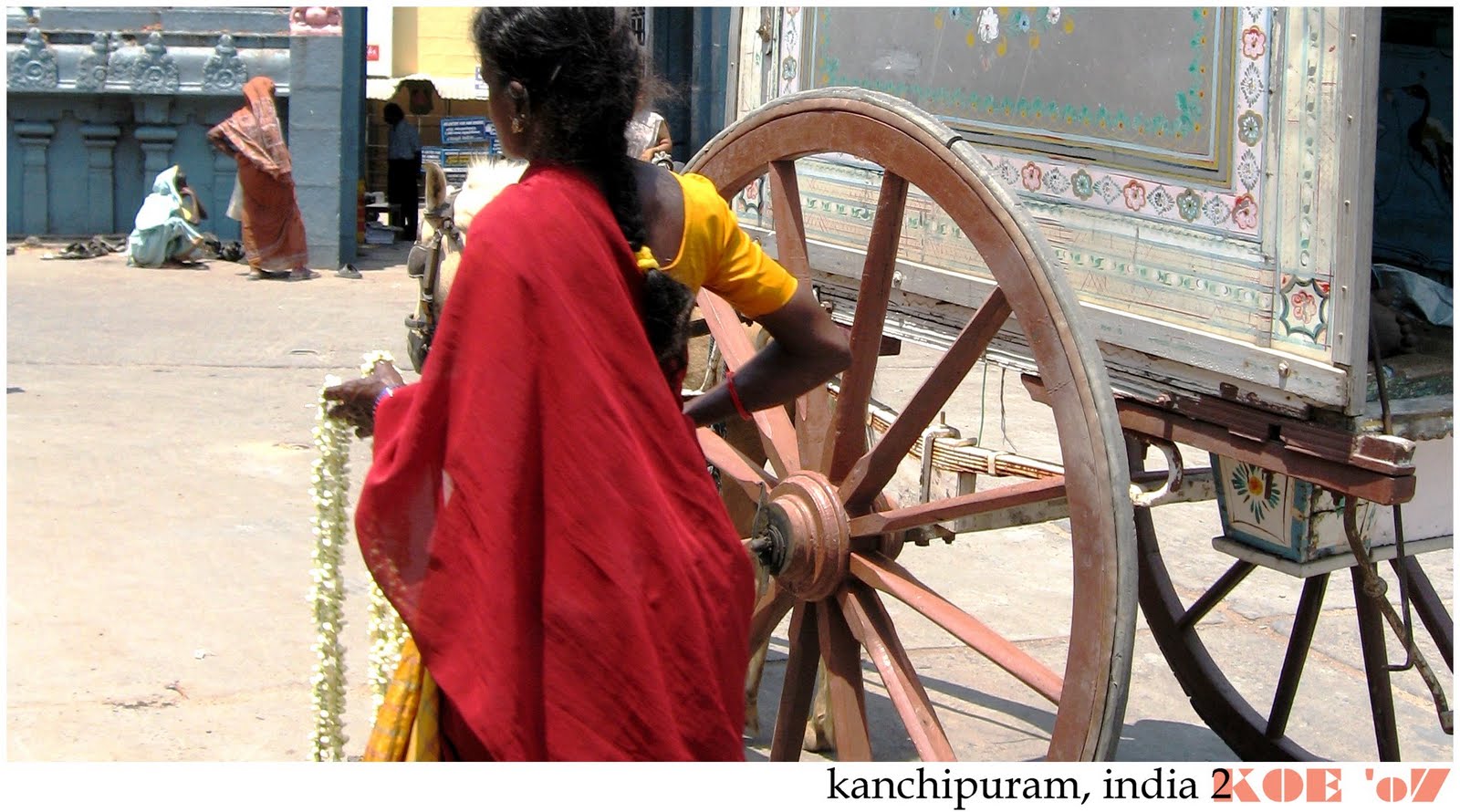
The accompanying photos here are of Kanchipuram, a busy and chaotic South Indian city with a rich historical tapestry. Every one of its temples is notable, each with a rich history of its own. A person with a camera could easily spend himself and dissolve into a pool of sweat in the unrelenting tropical heat before having recorded even a fraction of all that is here to see. For a brief instant I was blessed, being afford a moment that went even beyond seeing - beyond time. It is therefore altogether fitting that no record exists.
Peter Koelliker; pkoelliker8@yahoo.com
It’s probably one, or any combination of the above that happened to me while visiting Kanchipuram (the city of one thousand temples) in Tamil Nadu, so I just have to paint you a word picture: Apart from the obvious, we had heard of an ancient Jain Temple that was said to be undergoing renovation. Our driver managed to find it. Not much work was evident here; in fact, it was mostly a ruin. It was in a part of town where outsiders seldom visit; therefore, our car caused quite a stir. We had come to see the temple we explained to the people who crowded around us. Soon somebody sent for the old woman who lived down the block who, it was said, had been entrusted with the key.
By the time she showed up with a key that was almost as big as herself, the crowd was still growing. We were told that this particular temple, though now mostly in ruins, held a most beautiful idol in its inner sanctum. The crowd parted to let the old woman through. She stepped gingerly across the rubble on calloused feet and led us to a great wooden door. An ancient lock secured the bolt. It looked like it hadn’t been opened for centuries. As she struggled with the key, we began to have doubts.
Finally, it clicked and the lock sprang open. Some youths rushed forward to help her with the door. It shuddered and creaked in agonizing protest. Every inch was fought. More brawn was added and, at last, the great door swung open. There was a tremendous sound emanating from the inside; it gathered, and virtual cloud of black bats flew out from the darkness, their wings stirring a breeze that ruffled our hair on an otherwise breathless afternoon. More bats followed in volleys.
The sight was so strange; I forgot to reach for my camera. In fact, it felt like I had been transported back to a time when there were no cameras. I even doubted my own existence.
At first, there was nothing to see in the blackness inside. We squinted our eyes. Then, suddenly, we saw it: the idol. It was beautiful, indeed. I now understood why it needed to be locked up. Not that anyone of faith would steal it. It seemed inviolate. But there will always be those who would cart something sacred away to exhibit in their own carnival.
It seemed to shine with a light of its own, especially from a face that was the very definition of serenity. Again, I failed to reach for my camera. To take a picture now seemed the very definition of gauche.
The accompanying photos here are of Kanchipuram, a busy and chaotic South Indian city with a rich historical tapestry. Every one of its temples is notable, each with a rich history of its own. A person with a camera could easily spend himself and dissolve into a pool of sweat in the unrelenting tropical heat before having recorded even a fraction of all that is here to see. For a brief instant I was blessed, being afford a moment that went even beyond seeing - beyond time. It is therefore altogether fitting that no record exists.
Peter Koelliker; pkoelliker8@yahoo.com
Saturday, April 2, 2011
Cooper Mill, NJ
We found the place pretty much by accident. It was on the way to somewhere else. We noted the old stone building with a historical marker set out front. We’d never noticed it previously; maybe, because we’d never stopped at this particular tavern (for lunch) before.
Cooper Mill was across the street. Perhaps, we’d still be clueless if the girl hadn’t seated us by the window. So, after our meal, we decided to go over and have a look. It was a mill alright, with two millstones set out front to weather, and sacks of grain in the windows. There was a wooden aqueduct that funneled in water from a pond across the street, providing power to the big red wheel in back of the building. We would learn that two 2000 lb. millstones still grind significant quantities of grain even today; that this particular stretch along the Black River was particularly well-suited for mills of this type because the river drops a full 20 ft. within a mere half mile. Archaeological exploration of the area discovered no less than 13 sites tied to water-powered industry, among them a second gristmill downstream, a saw mill, a mill to crush apples, one to distill cider into whiskey, and one to process wool.
The people at the visitor center (located just across the parking lot) would have been only too happy to give us a tour of the one remaining (grist) mill. We didn’t want to trouble them. They looked quite delicate, lounging around the old house in their frilly period costumes. It never occurred to us that they might have been bored.
Before leaving, we grabbed a handful of brochures, some of which contained trail maps of the area which, we learned, comprises the Morris County Black River Park System. The trails all begin (if anything can be said to begin anywhere) at Cooper Mill. Chubb Park, the Kay Environmental Center, Bamboo Brook and Willowwood Arboretum are destinations. We walked down as far as the waterfall that marked the end of Kay’s Pond. One of the brochures promised painted turtles sunning themselves on the rocks. We only found the ubiquitous Canada Geese and the occasional reptile.
Eventually, the shadows were beginning to lengthen and we decided to turn back. We didn’t fancy being out in the woods after dark. Even now there were strange rustlings emanating from the brush close beside the path. A discernible chill had descended that made us shudder with each new animal yelp echoing through the distance.
While retracing our steps back to the Mill, our thoughts turned to men like Isaiah Younglove who began a flour milling operation here as far back as the 1760’s; and Nathan Cooper who would go on to populate (what was once called) Milltown with descendants, helping to turn it into a thriving industrial community. These men - the early architects of what would become America’s Industrial Revolution - could hardly have been as squeamish as we, traipsing through this then pathless wood.
Petert Koelliker; pkoelliker8@yahoo.com
Cooper Mill was across the street. Perhaps, we’d still be clueless if the girl hadn’t seated us by the window. So, after our meal, we decided to go over and have a look. It was a mill alright, with two millstones set out front to weather, and sacks of grain in the windows. There was a wooden aqueduct that funneled in water from a pond across the street, providing power to the big red wheel in back of the building. We would learn that two 2000 lb. millstones still grind significant quantities of grain even today; that this particular stretch along the Black River was particularly well-suited for mills of this type because the river drops a full 20 ft. within a mere half mile. Archaeological exploration of the area discovered no less than 13 sites tied to water-powered industry, among them a second gristmill downstream, a saw mill, a mill to crush apples, one to distill cider into whiskey, and one to process wool.
The people at the visitor center (located just across the parking lot) would have been only too happy to give us a tour of the one remaining (grist) mill. We didn’t want to trouble them. They looked quite delicate, lounging around the old house in their frilly period costumes. It never occurred to us that they might have been bored.
Before leaving, we grabbed a handful of brochures, some of which contained trail maps of the area which, we learned, comprises the Morris County Black River Park System. The trails all begin (if anything can be said to begin anywhere) at Cooper Mill. Chubb Park, the Kay Environmental Center, Bamboo Brook and Willowwood Arboretum are destinations. We walked down as far as the waterfall that marked the end of Kay’s Pond. One of the brochures promised painted turtles sunning themselves on the rocks. We only found the ubiquitous Canada Geese and the occasional reptile.
Eventually, the shadows were beginning to lengthen and we decided to turn back. We didn’t fancy being out in the woods after dark. Even now there were strange rustlings emanating from the brush close beside the path. A discernible chill had descended that made us shudder with each new animal yelp echoing through the distance.
While retracing our steps back to the Mill, our thoughts turned to men like Isaiah Younglove who began a flour milling operation here as far back as the 1760’s; and Nathan Cooper who would go on to populate (what was once called) Milltown with descendants, helping to turn it into a thriving industrial community. These men - the early architects of what would become America’s Industrial Revolution - could hardly have been as squeamish as we, traipsing through this then pathless wood.
Petert Koelliker; pkoelliker8@yahoo.com
Monday, March 28, 2011
San Thome Cathedral, Chennai, India
Whereas in the West, Catholic priests generally wear black robes, here in India – perhaps in an appropriate concession to the heat - they are more likely to wear white. Similarly, Christian churches here are overwhelmingly white(washed). And so, possibly the most important Christian church in all of India, the one Pope Pius XII himself elevated to the status of a minor basilica in 1956, is a great gothic monument - brilliantly white - overlooking the Bay of Bengal from the modest hill on which it was built over the remains of St. Thomas (Doubting Thomas), one of Jesus’ own twelve apostles.
Hinduism, the dominant religion in India, has always been exceptionally tolerant of other faiths. I have seen statues of the Virgin Mother lovingly attired in colorful saris; I have seen images of Jesus alongside the deities in Hindu temples. There has been some hardening of this ecumenical position of late in response to Islamist fanatics hell-bent on desecrating anything that is not Islam.
Legends of St. Thomas’ life in India abound. At one point, it is said that a huge log washed down the Adyar River and got stuck at its mouth, causing significant flooding upstream. The king called out his army to dislodge it. Try as they might, they couldn’t budge the log. The king had heard rumors of an ascetic living in a cave up in the hills of whom it was said that he could perform miracles. The king sent a messenger to fetch him. St. Thomas came; touched the log with the girdle the Virgin Mother had dropped at the time of her assumption, which St. Thomas always wore around his waist; spent some moments in silent prayer and then asked the king’s men to pull the log aside. They were able to do so without difficulty.
The belief in St. Thomas’ ability to perform miracles continues to this day. Christians from far and wide converge steadily on San Thome Cathedral to pray for the Saint’s personal intervention in regard to some problem they might be experiencing. In December of 2004, when the tsunami hit the east coast of India, it is now widely believed that St. Thomas’ Pole (fashioned from the legendary log) which stands between the sea and the church, was responsible for saving the lives of the people living in the Foreshore Estate, a neighborhood comprised primarily of fishing villages.
San Thome Basilica in Chennai is well worth a visit. There’s a delicious irony between Indian exotica and the (starkly geometric) cross. Besides the grand interior of the Basilica, the complex contains the Eucharist Chapel, the Tomb of St. Thomas (also with Chapel), a modest museum, boasting of St. Thomas relics such as the spearhead that killed the beloved saint.
There is a small gift shop where any number of items associated with St. Thomas can be purchased. By far the most popular item is a wallet size card embedded with the sand from the Saint’s tomb which is said to have miraculous healing powers. Other items include post- and laminated prayer cards in various Indian languages as well as a quarterly news magazine entitled, Voice of St. Thomas.
Peter Koelliker; pkoelliker8@yahoo.com
Monday, March 14, 2011
Navaratri ‘Kolu’ (India)

As a small child growing up in Kerala, I was quite unaware of the vibrancy; of the intensity and vitality of ‘Kolu’, which is an integral part of Navaratri, a celebration of the Goddess Durga. I was introduced to its color and pageantry only after my mother and I relocated to Bangalore in Karnataka, a state that is in many respects synonymous with the traditions of Navaratri (also known there as Dasara). It didn’t become a part of me until age seven; this, the ‘Kolu’ festival in which terracotta dolls are decorated and displayed on tiers in every Hindu home, (much like the spirit in which Christmas trees are decorated in the West), capturing and holding - for a brief nine nights and ten days - the child in all of us.
This display of dolls and decorative floral designs during Navaratri is seen mostly in the south Indian states of Tamil Nadu, Andhra Pradesh and Karnataka. The south Indian Diaspora celebrates ‘Kolu’ in the same traditional way, recreating this familiar cultural landscape wherever in the world they may happen to find themselves.
In the patriarchal north of India, Dasara is symbolic of the mythological victory of Ram over Ravana, the ten-faced demon king of Lanka. On the tenth day, a huge effigy of Ravana is torched amid a noisy fireworks display. There is joy and jubilation all around. ‘Good’ has prevailed over ‘evil’ once again. The ‘Ram Lila’ (as this ten-day enactment is called) in north India, like the ‘Kolu’ in the south, is inexorably woven into the memories of childhood.
Meanwhile in the south, as well as in the state of West Bengal, Dasara is a ten-day celebration of the Mother Goddess in all her multifarious forms: She is Chamundi who slays the buffalo demon in a ten-day battle in Mysore; she is Saraswati, the Goddess of learning, in Kerala; she is Bhavani who rides on a tiger in Gujarat and Maharashtra; Lakshmi, the goddess of wealth, in Tamil Nadu; and Ma Durga who rides on a lion in West Bengal. She is said to be stern, yet compassionate.
The tenth morning - also called ‘Vijayadsami’ (or the ‘victorious tenth day’) - the very young are initiated into learning and for those who have already begun their studies it serves as a reminder that learning is an ongoing experience.
In India, the mythic and the ordinary co-exist, and in these festivals one sees them merge. Religion (or faith) becomes a living, breathing amalgamation, very much rooted in the organic expression of everyday life. It does not much matter to people that Ram or Durga are only metaphors. What matters is the celebratory nature of life in all its various aspects. Little girls and boys dress in festive finery. The girls in long, shimmering silk skirts with flowers in their hair take their little brothers to visit neighbors in order to see the dolls, decorated and exhibited on tiers. All those who visit are given tiny dolls, flowers, and sweets; each item prettily wrapped and put in special thamboolam bags made of silk.
The tiered arrangement of the dolls is to adhere to a specific protocol: the bottom tier is laid out with fruits and flowers; the topmost tier has regular panoply of gods and goddesses with Durga taking pride of place. The tiers between are meant to represent people from all walks of life—in essence, a microcosm showcasing both, the human and the divine dimensions.
I remember these celebrations so vividly. The lights, the colors, the smell of jasmine and incense; the lively chatter of my friends as we visited the various neighborhood ‘Kolus’; the busy adults; the scrumptious food; the dolls we so preciously decorated and displayed; the tiers so painstakingly arranged; the abundance of fruits and flowers; the strains of someone playing notes in praise of the goddess on the veena; of giggling helplessly at the incomprehensible lyrics; the embarrassment when asked to perform; the wonderful hubbub of those ten days that are but a pause before the free-fall of Diwali.
Parvathi Venkatraman; Chennai, India


Subscribe to:
Posts (Atom)